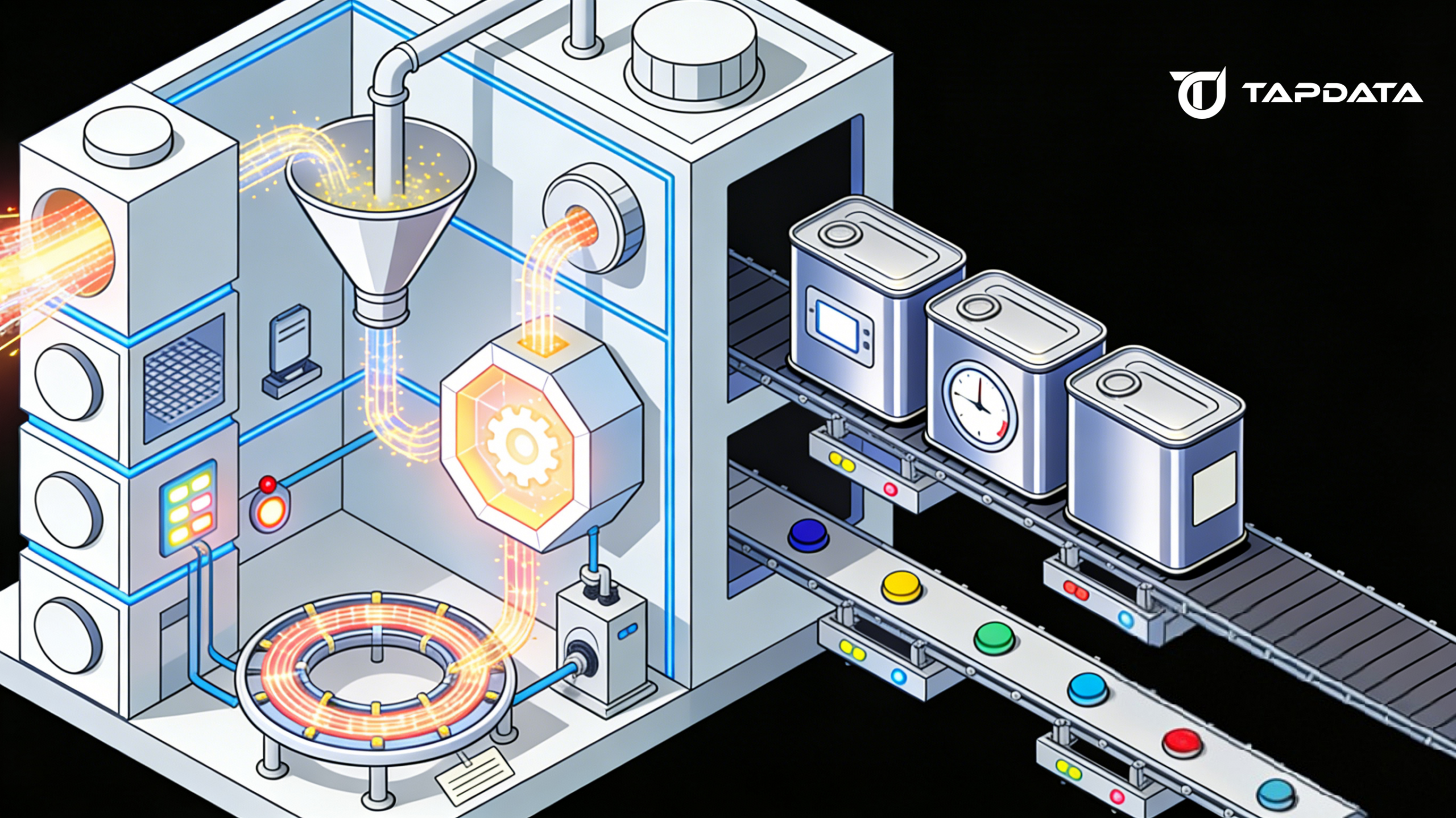
In any Data as a Service (DaaS) platform, materialized views are the workhorses. They turn raw change data into usable, queryable, governed data products. They’re how dashboards stay up-to-date, how APIs stay consistent, and how developers stop writing the same SQL over and over.
If you’re new to the idea, start with the complete DaaS guide. For context, we’ve also covered DaaS vs ETL and DaaS vs iPaaS, and practical use cases.
But building materialized views for real-time, multi-consumer environments isn’t the same as caching a SQL query every hour. It raises hard questions about freshness, recomputation, access control, and versioning.
In this article, we break down what a materialized view should do in a real-time DaaS platform, why much fail to deliver, and how TapData approaches the challenge differently.
Why Materialized Views Matter in DaaS
A materialized view in a DaaS context isn’t just a faster table. It’s a semantic layer and a delivery layer combined:
-
It defines what data means (entities, relationships, derived fields)
-
It enforces how data is shaped and accessed (joins, filters, security rules)
-
It determines when data is delivered (freshness, scheduling, reactivity)
More importantly, it decouples data producers from data consumers. A well-modeled view lets five teams consume the same logic—without each rebuilding it from scratch.
If your DaaS platform is just publishing raw table APIs, it’s not solving the hardest part: standardizing and serving reliable business logic.
What a DaaS View Needs to Get Right
In practice, a good materialized view in a DaaS platform should meet six non-negotiable requirements:
-
Freshness that fits the use case Not all views need sub-second latency, but every view should have an explicit SLA. Dashboards might need updates every 5 seconds; ML features, every minute. A view without a freshness contract is just a guess.
-
Resilience under change Schema changes, late-arriving events, and upstream outages shouldn’t cause the view to break silently—or worse, serve wrong data. The pipeline behind it needs replays, idempotency, and schema evolution handling.
-
Governance and observability Who can see what fields? Who accessed what and when? What’s the lineage? Materialized views should be first-class assets with policies, access control, and logs—not invisible objects behind an API gateway.
-
Versioning and compatibility Business logic changes. Breaking that change into a new versioned view (
v2) lets old consumers keep running while new ones adopt improvements. This is vital in multi-team environments. -
Composability and reuse Can you define a core entity once and reuse it across APIs, dashboards, and ML jobs? Or are teams copy-pasting pipelines with small changes and diverging logic?
-
Efficient serving Materialization should avoid unnecessary recomputation. The view engine needs to track deltas, not just rerun everything. This is especially important in streaming environments.
Where Traditional Materialized Views Break
Many systems claim to support materialized views—but under the hood, they struggle with real-time, multi-tenant, governed use cases. Common failure modes include:
-
Stale data due to batch-only refresh cycles
-
Tight coupling to specific consumers, forcing redundant copies per use case
-
Lack of schema tolerance, causing brittle views that fail on every column change
-
No lineage or access controls, turning views into black boxes
-
Manual recomputation, requiring ops teams to rebuild views on every pipeline change
These aren’t theoretical problems—they’re exactly what breaks when DaaS moves from POC to production.
How TapData Handles Materialized Views Differently
At the core of TapData DaaS, materialized views are treated as governed, live, composable, and observable assets.
-
Live updates via log-based CDC Changes are ingested continuously and propagated through streaming pipelines with minimal delay.
-
Low-code, semantic modeling Users define entities, joins, filters, and derived fields through a visual interface—then publish as views or APIs with shared definitions.
-
Field-level governance Every view supports RBAC, field masking, and audit logging. No guesswork on who can see what.
-
Versioned contracts A view schema can be versioned. Consumers choose which contract to bind to, reducing upgrade friction and dependency churn.
-
Delta-aware recomputation Views are incrementally updated, not fully rebuilt, enabling cost-efficient delivery at scale.
-
View as API Any view can be exposed as a real-time API with pagination, throttling, and consumer identity attached.
This approach ensures that materialized views don’t just serve data—they serve it correctly, consistently, and reliably, across teams and use cases.
When Should You Use a Materialized View?
In TapData, you can choose between raw CDC streams, modeled views, and full APIs. So when should you use a materialized view?
Use it when:
-
Multiple consumers need the same logic
-
Joins, filters, or enrichments are required
-
The data should be queryable on demand
-
Governance, versioning, or observability matter
If you just need a raw stream or append-only log, a materialized view might be overkill. But if you're delivering data as a product, it’s the right abstraction.
Conclusion
Materialized views are where real-time data becomes usable, trustworthy, and scalable. They’re not just a cache—they're the core of any real DaaS platform.
If your current setup treats views as an afterthought, it’s time to rethink what you’re building.
>>> Learn more in our Complete Guide to DaaS
📩 Want to see it live? Request a demo
Related Blogs:
- Buyer’s Guide: How to Evaluate a Data as a Service (DaaS) Platform in 2025