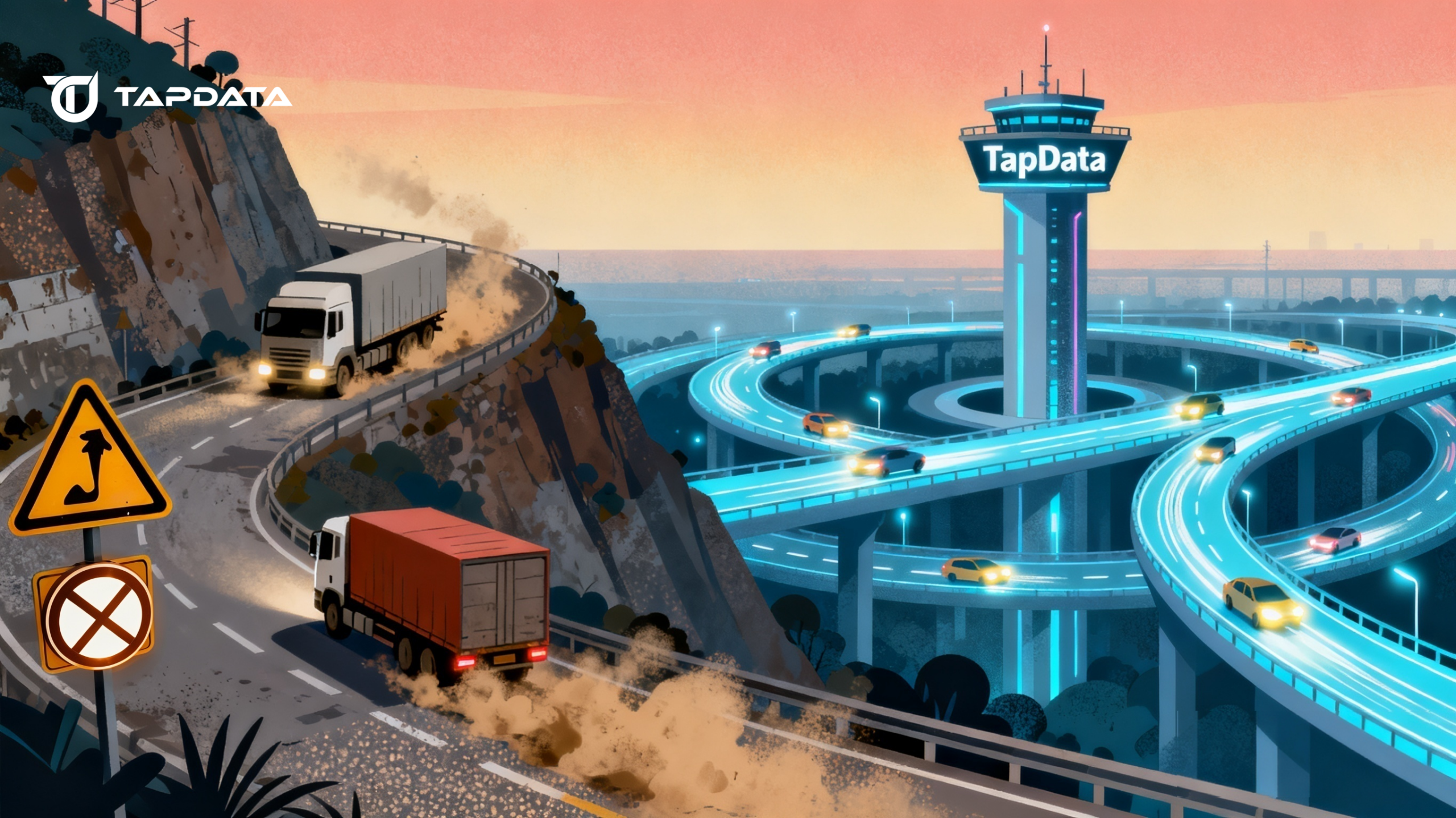
The night your batch jobs fail is the night your dashboard becomes fiction. Most teams have lived through that: a “daily” pipeline that isn’t really daily, hotfixes stitched into one-off scripts, and every new consumer asking for yet another copy of the same data. Data as a Service (DaaS) is the pivot away from that gravity. Instead of wiring every app to every source, a DaaS platform exposes governed, reusable services—APIs and materialized views—so product teams can read the truth on demand.
If you’re new to the idea, start with the complete DaaS guide. For context, we’ve also covered DaaS vs ETL and DaaS vs iPaaS, and practical use cases.
Why teams move to DaaS now
Microservices, embedded analytics, and machine-assisted decisions have shortened the distance between an event and a customer experience. The old model—copy data into a warehouse and wait—still has its place, but more work now depends on real-time DaaS: low-latency access, shared definitions, and a clean contract between data producers and consumers. Done well, a DaaS architecture reduces one-off integrations without forcing everyone into a single database or tool.
What “real-time DaaS with TapData” looks like
At a high level, TapData keeps operational changes flowing into a service layer that applications can trust.
Ingest (CDC). Changes are captured from operational systems using log-based CDC, so downstream views stay current without hammering source tables. Initial loads bring you to parity; continuous capture keeps you there.
Stream & stabilize. A streaming data plane preserves ordering, tolerates schema evolution, and supports replay when you need to recover or backfill. The goal isn’t flashy complexity—it’s predictable freshness and graceful failure handling.
Model once, use many. In TapData, teams define business entities and relationships—joins, filters, derivations—on streaming data. These models become a shared vocabulary rather than another per-consumer transformation.
Serve as APIs and views. The modeled outputs are published as materialized views and REST endpoints. Consumers pull Data as a Service when they need it, without brittle point-to-point connections to every source.
Govern and observe. Access is role-based, sensitive fields can be masked, and usage is auditable. End-to-end metrics—latency, throughput, error rates—make operating a DaaS platform routine instead of heroic.
A pragmatic architecture, not a science project
Real systems are messy. TapData leans into that reality:
-
Freshness vs. cost. Not every domain needs sub-second updates. Pick SLOs that reflect how the data is used, and model to that—some views can be truly live, others micro-batched.
-
Eventual consistency exists. DaaS favors decoupling; consumers should assume data can arrive slightly out of order and design for idempotency.
-
Schema changes happen. Add fields without breaking consumers; deprecate with versioned contracts rather than sudden rewrites.
-
Warehouses still matter. Historical analysis and heavy batch work belong there. Real-time DaaS handles operational reads and API-driven use cases; the two layers complement each other.
Getting from here to there
Most teams don’t “boil the ocean.” They start where latency hurts:
-
Pick a domain with clear pain—orders, customers, or inventory—and write down a freshness target and basic access rules.
-
Configure CDC to that source and run the initial load.
-
Model the core entities once—shared joins and definitions pay off fast.
-
Publish one or two real-time DaaS endpoints and route early consumers to them.
-
Add observability and alerts before you add more consumers.
-
Iterate: tighten contracts, version what needs to change, and expand to the next domain.
Where TapData fits
TapData brings the pieces together: log-based CDC, streaming-aware modeling, materialized views and APIs in one place, with governance and observability built in. For many teams, that means fewer pipelines to maintain, less drift in definitions, and a faster path from an operational event to a product feature. It also plays well with what you already have: ETL for big historical loads, an iPaaS for process orchestration, and a warehouse/lake for analytics—TapData simply becomes the service layer those systems can rely on.
Outcomes to expect
You’ll notice the changes in how people work: fewer tickets for one-off extracts, shared contracts instead of ad-hoc SQL, dashboards that don’t lag the business, and partner integrations that negotiate an API—not a direct line into your database. That’s TapData DaaS doing its job: turning fragmented data into a dependable service that multiple consumers can share.
📩 Want a deeper dive? Read the complete DaaS guide. Ready to see it with your data? Request a live demo.
Related Blogs: