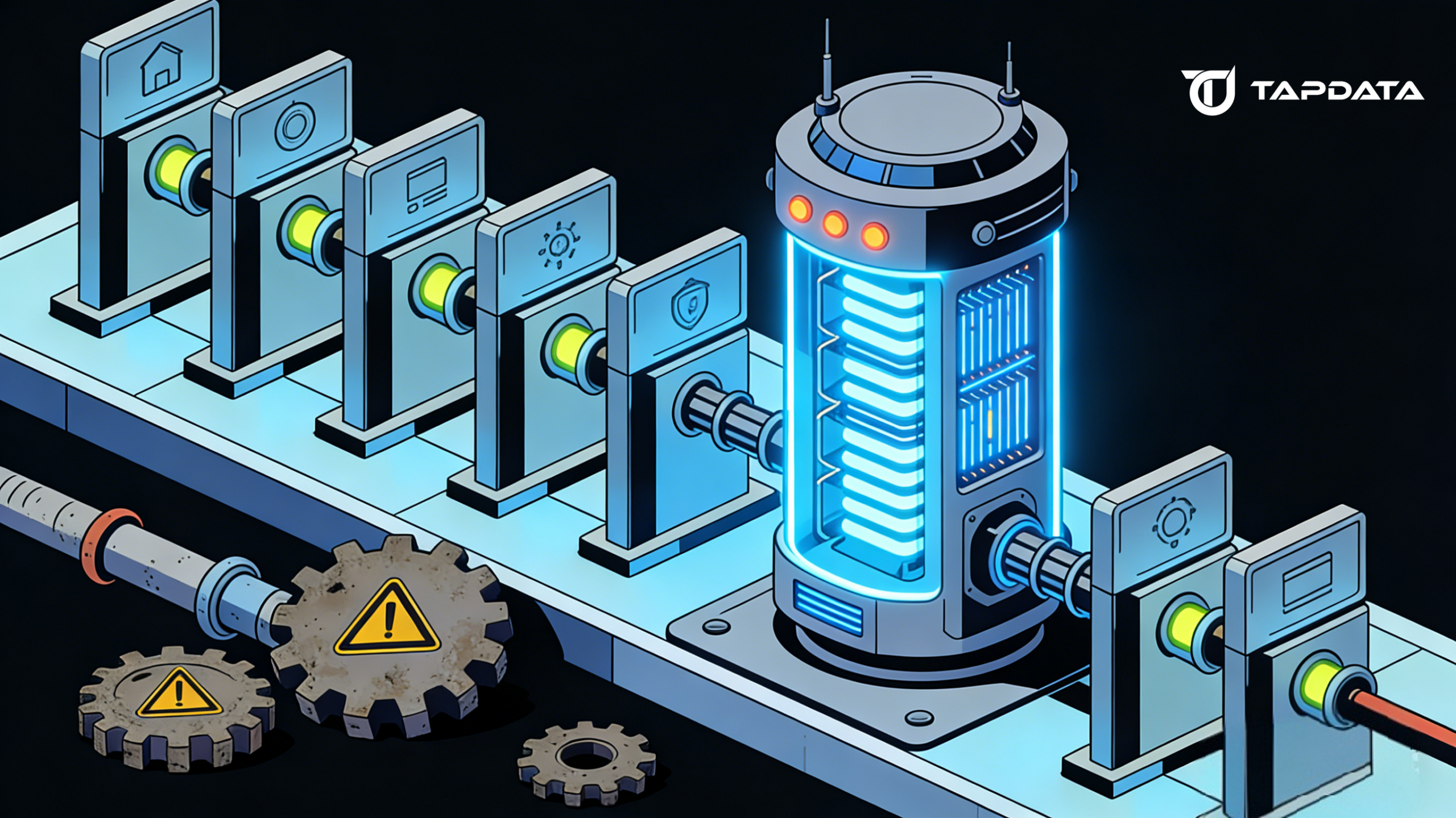
Every modern enterprise is sitting on a web of APIs, databases, apps, and pipelines. But the real challenge isn’t “getting data out”—it’s delivering the right data to the right consumer in a consistent, governed, and real-time manner. That’s where Data as a Service (DaaS) platforms come in.
Yet, not all DaaS platforms are created equal. Some promise real-time access but rely on batch pipelines underneath. Others offer slick API builders but no real governance, traceability, or fault tolerance. If you're evaluating DaaS options in 2025, you're not just buying a tool—you're choosing how your entire organization consumes and trusts its operational data.
This guide breaks down what to look for, what to avoid, and how platforms like TapData DaaS align with enterprise-grade expectations.
The Role of a Modern DaaS Platform
Before we get into features and comparison checklists, let’s align on what a true DaaS platform does:
-
Decouples source and consumer. You don’t want every dashboard, ML model, and partner integration pinging your production DB.
-
Delivers data on demand. Think APIs or queryable views—not flat files or message queues.
-
Keeps data fresh. Near-real-time sync matters for operational use cases.
-
Supports multiple consumers. One model, many outputs—not “one pipeline per dashboard.”
-
Applies governance natively. Field-level access control, auditability, and schema evolution should be table stakes.
DaaS is not iPaaS. It's not ETL. It's a data delivery layer, optimized for operational speed and integrity.
>>> Want a primer first? What is DaaS? Start here.
Red Flags to Watch For
Here’s what “DaaS-in-name-only” platforms might try to sell you:
-
Batch-only backends. If the source-to-service path only refreshes nightly or hourly, it’s a data warehouse API, not real-time DaaS.
-
No change data capture (CDC). Without CDC, you’re doing full loads or relying on timestamp filters. That won’t scale.
-
Black-box transformations. Can you audit how data is being shaped? Are models shared across teams?
-
Weak schema management. What happens when upstream columns change?
-
API ≠ service. Publishing a REST endpoint is easy; ensuring it delivers governed, up-to-date data is hard.
What to Look For in a Real-Time DaaS Platform
Now for the good part. Here's what matters in a production-grade DaaS platform:
Real-Time CDC Ingestion
The platform should support log-based CDC from major databases (e.g., MySQL, PostgreSQL, MongoDB, Oracle), with full support for schema evolution, replays, and exactly-once semantics where possible.
Streaming-Aware Modeling
It’s not enough to run transformations—those transformations should operate on change streams. Bonus points for low-code modeling with shared entity definitions.
API & View Publishing
The ability to expose materialized views or RESTful APIs with RBAC, field masking, and quotas is core to DaaS. Bonus: versioning and contract enforcement.
Governance by Design
You should be able to define access policies, audit usage, and control schema changes without scripting. Multi-tenant or domain-scoped controls are increasingly essential.
Observability & Reliability
Monitoring data freshness, delivery latency, and schema drift should be built in, not bolted on. Error handling and reprocessing are critical.
Flexible Deployment
Support for hybrid/cloud-native/self-managed is a must for many industries. You shouldn't be locked into one mode.
How TapData Aligns with These Principles
TapData DaaS is built to power real-time, governed data delivery for enterprises. Highlights include:
-
Log-based CDC for major OLTP systems
-
Streaming-native, low-code modeling layer
-
Publishing to both materialized views and versioned REST APIs
-
Field-level masking, contract versioning, and multi-role RBAC
-
Full observability across latency, throughput, and pipeline status
-
Available as cloud, self-managed, or hybrid deployment
Questions to Ask Your Vendor
Before you commit, ask vendors:
-
What is your real-time latency SLA for published data?
-
How do you handle upstream schema evolution?
-
Can I model once and reuse across consumers?
-
Can I restrict access by field, role, or consumer app?
-
How do you ensure API contracts are stable across changes?
-
Do I need to build and operate my own pipelines, or is that included?
Conclusion: DaaS is a Layer, Not a Feature
A true DaaS platform doesn’t just let you expose data—it guarantees that what you expose is fresh, consistent, governed, and observable. In 2025, data consumers expect more than flat files and brittle APIs. The good news? Platforms like TapData make it practical to deliver DaaS at scale—without building everything yourself.
📩 Want to see how it fits your stack? Book a live demo New to DaaS? Start with the guide
Related Blogs: