TapData 4.23: SAML SSO, Granular Permissions, and Better Operational Control
As real-time data platforms grow, the challenge is no longer only keeping data moving. More users, projects, pipelines, and operational systems also create new requirements around identity, access control, alert management, traceability, and long-running reliability.
TapData 4.23 focuses on those production concerns.
This release introduces SAML-based single sign-on, expands role and data permissions across more parts of the platform, makes alert recipient management easier at scale, improves field lineage through JavaScript transformations, and strengthens the handling of sensitive configuration information.
Together, these updates make TapData easier to govern and operate as real-time data workloads grow.
Bring TapData into your enterprise identity environment with SAML SSO
TapData 4.23 adds SAML-based single sign-on, allowing organizations to connect TapData with an existing enterprise identity system instead of maintaining a separate login experience for every user.
For organizations with centralized identity management, multiple teams, or stricter account governance requirements, this makes TapData easier to fit into established access-management processes.
Users gain a more consistent sign-in experience, while administrators have a clearer path for managing access through the identity infrastructure already used across the organization.
The result is less account-management overhead and a more unified approach to platform access.
Apply permissions across more platform resources
Identity is only one part of enterprise access control. Once users enter the platform, administrators also need to control what different teams and roles are allowed to see and operate.
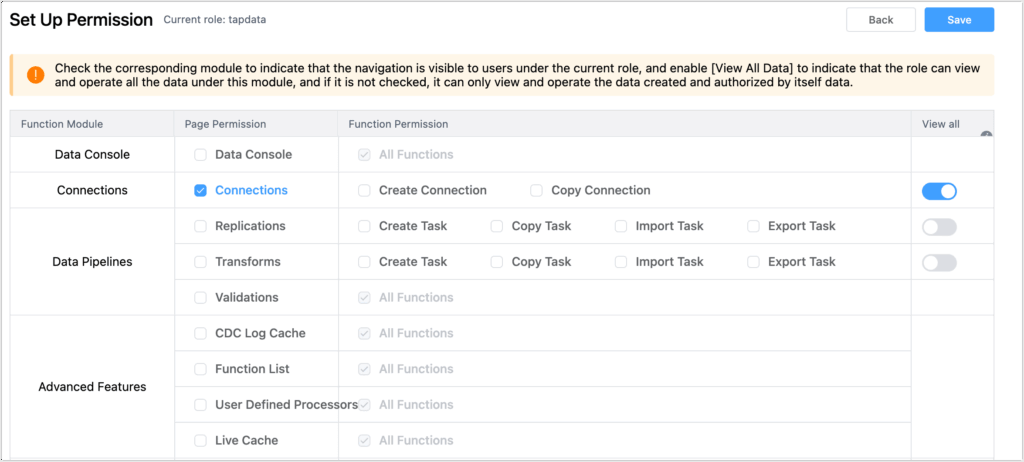
TapData 4.23 expands its role and data permission model across more product areas, including user management, projects, data validation, shared services, and other platform resources.
This gives administrators more control over how access boundaries are defined for different teams and responsibilities.
Instead of exposing the same set of resources to everyone using the platform, organizations can more clearly separate the information and operations required by each role.
For environments where several teams share the same real-time data platform, this helps maintain collaboration without giving every user unnecessary access.
Permissions can then be applied more precisely to the resources and operations available to that role, making it easier to align TapData access with internal responsibilities.
Manage alert recipients across multiple tasks
Operational overhead grows quickly when the number of replication and transformation tasks increases.
A simple configuration change can become repetitive when operators have to open and update tasks one by one.
TapData 4.23 introduces batch configuration of email alert recipients directly from replication and transformation task lists. Teams can apply recipient changes across multiple tasks without editing every task individually.
This is particularly useful when a group of tasks is launched together, operational ownership changes, or an organization needs to update its alerting policy across many pipelines.
Instead of treating alert configuration as a task-by-task maintenance activity, administrators can make these changes more efficiently and reduce the risk of missed or inconsistent recipient settings.
This improvement is small at the individual-task level, but becomes increasingly useful as production environments scale.
Keep field lineage intact through JavaScript transformations
JavaScript processing nodes are often used to reshape data, apply custom logic, or rename fields as records move through a pipeline.
Those transformations can make lineage harder to interpret when the name of a field changes between upstream and downstream stages.
TapData 4.23 improves field-mapping analysis for JavaScript nodes. When a field is renamed in JavaScript processing, TapData can more accurately recognize the relationship between the original field and its downstream representation.
That gives teams a clearer view of how data changes as it moves through a transformation path.
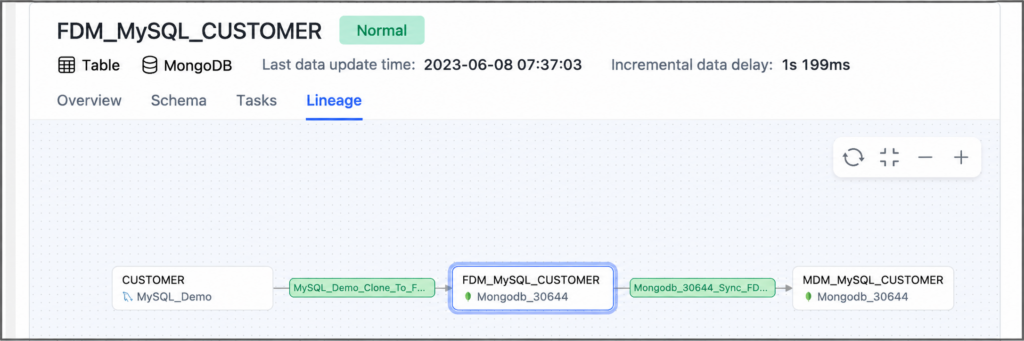
More complete field relationships are useful when teams need to understand the impact of an upstream change, investigate an unexpected result, or explain where a downstream field originated.
For complex transformation pipelines, maintaining that continuity can make troubleshooting, change assessment, and data governance considerably easier.
Stronger protection for sensitive configuration data
Production platforms inevitably contain information that should not travel freely with exported configurations.
TapData 4.23 strengthens the handling of sensitive information across several areas, including task exports, project import and export, and external storage configuration.
The goal is to reduce the risk that credentials or other sensitive configuration values are unintentionally exposed when configurations are exported, transferred, or reused.
These changes complement the release's broader focus on access control: SAML SSO helps govern who enters the platform, permissions determine what users can access, and improved sensitive-information handling reduces unnecessary exposure when configuration artifacts leave their original context.
More reliable day-to-day operations
TapData 4.23 also includes a collection of improvements aimed at long-running production environments.
Task log cache lifecycle management has been improved to reduce the risk of abnormal cache growth affecting disk usage over time. Alerting, monitoring queries, and runtime statistics have received additional fixes and refinements to make routine investigation more dependable.
The experience of browsing large data sources has also been improved. Table-tree search and expansion are easier to use when a source contains a large number of objects, while long table names are presented more clearly.
These changes are less visible than a new feature such as SAML SSO, but they address the operational details that increasingly matter as the number of tasks, users, and source objects grows.
A more manageable real-time data platform
TapData 4.23 is primarily a release about operating the platform at enterprise scale.
SAML SSO makes enterprise identity integration easier. Expanded permissions provide more control over who can access platform resources. Batch alert management reduces repetitive administration. Better JavaScript field lineage makes transformed data easier to understand. Improvements to sensitive-information handling, logging, monitoring, and large-source navigation strengthen the operational foundation underneath those capabilities.
For teams running more pipelines across more systems and involving more users, these changes help make the platform easier to govern, easier to investigate, and easier to maintain.
To learn more about TapData 4.23, see the latest release notes or contact the TapData team for upgrade guidance and a product walkthrough.
Explore the release in more detail
Review the full release notes for technical details, or talk to the TapData team about upgrade planning and how these capabilities fit your data environment.
Prefer a live conversation? Book a meeting →