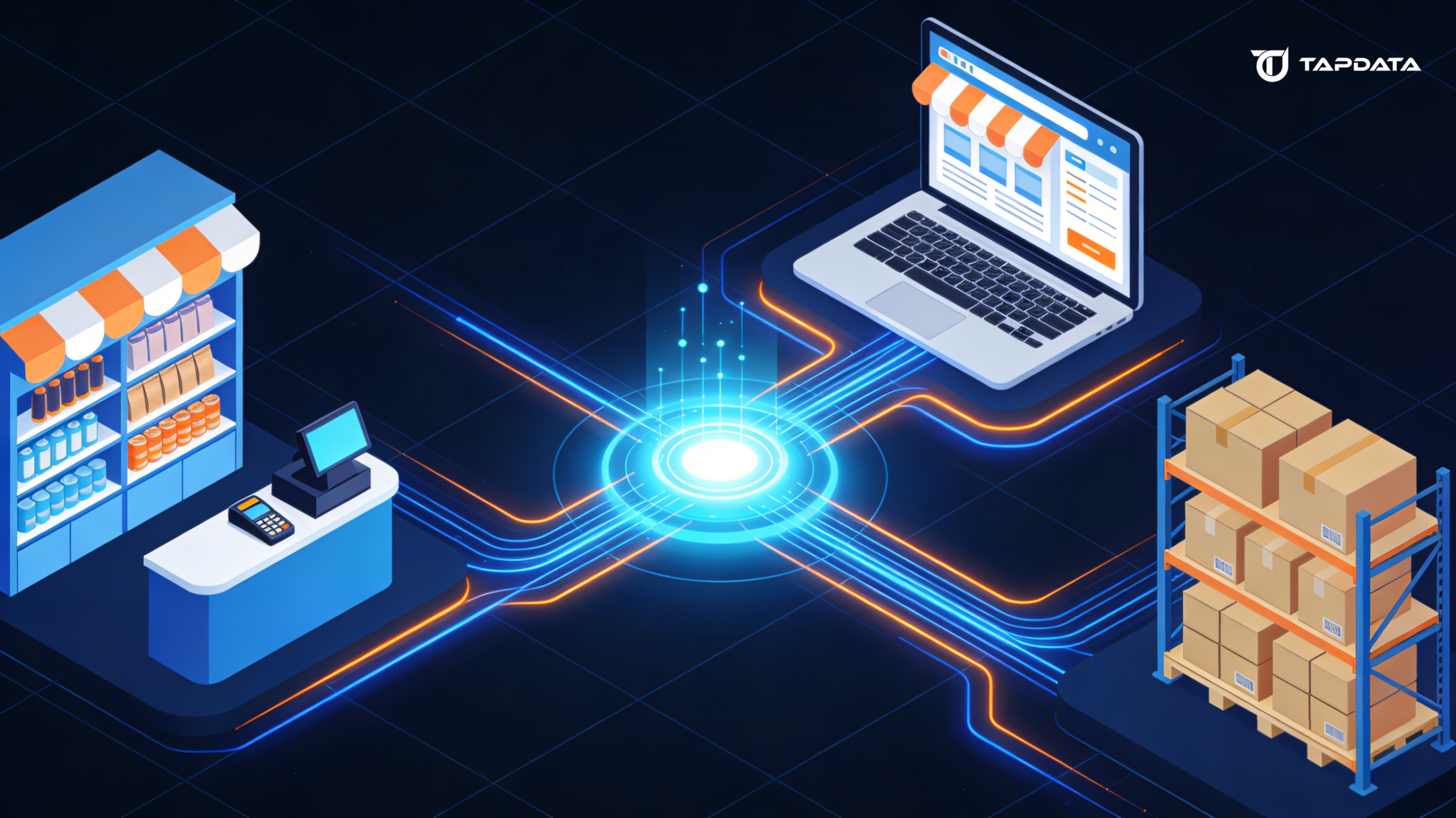
For modern retailers, inventory is the heartbeat of the business. Yet, most still struggle with a painful reality: inventory data is scattered across POS terminals, e-commerce platforms, warehouse management systems (WMS), and ERP solutions. When these systems don’t speak to each other in real time, the result is over-selling, stockouts, frustrated customers, and lost revenue.
Traditional batch ETL processes—updating inventory every hour or every night—are no longer sufficient in an era where customers expect to see accurate stock levels whether they shop in-store, on mobile, or via a marketplace. The solution lies in Change Data Capture (CDC), a technology that streams data changes as they happen. This guide explains how retailers can use CDC to build a real-time, unified inventory hub and why TapData’s approach is purpose-built for this challenge.
The Omnichannel Inventory Problem
Retailers typically manage inventory across multiple disconnected systems:
| System | Data Role | Typical Update Frequency |
| POS | In-store sales and returns | Real-time at register |
| E‑commerce (Shopify, Magento, etc.) | Online orders and cancellations | Real-time via API |
| WMS | Stock movements, transfers, receipts | Batch (every 15–60 min) |
| ERP | Procurement, cost, master data | Batch (daily) |
When these systems are not synchronized in real time, retailers face:
-
Over-selling: An item sells out in a store, but the e‑commerce site still shows “in stock” for hours.
-
Inventory fragmentation: A store has excess stock while a nearby store is out of the same SKU, but no visibility exists to enable transfers.
-
Inefficient fulfillment: BOPIS (buy online, pick up in store) orders fail because store inventory data lags behind actual availability.
-
Manual reconciliation: Staff waste hours on spreadsheets to correct discrepancies between systems.
Solving this requires a data architecture that can capture changes instantly from every source and make them available everywhere—with minimal load on production systems.
Why CDC Is the Right Approach
Change Data Capture (CDC) listens to the transaction logs of databases (such as MySQL, PostgreSQL, Oracle, or SQL Server) and streams every insert, update, or delete as it occurs. Unlike batch ETL, CDC provides:
-
Sub-second latency – Inventory changes reflect in all channels within milliseconds.
-
Low impact on source systems – No extra queries or timestamps; CDC reads the existing database logs.
-
Exactly-once semantics – Ensures no data loss and no duplication, critical for transaction integrity.
-
Schema evolution handling – Automatically adapts when source tables change (e.g., a new column is added).
For retailers with hundreds of stores or complex ERP backends, a distributed CDC platform is the only way to maintain a single source of truth for inventory without overwhelming operational systems.
Building a Real‑Time Operational Data Hub for Inventory
TapData’s approach centers on creating an Operational Data Hub (ODH)—a centralized, always‑fresh data service layer that aggregates inventory data from all source systems and exposes it via APIs or materialized views.
The architecture follows three steps:
-
Capture with CDC
TapData connectors use log‑based CDC to continuously replicate data from:
-
POS databases (on‑prem or cloud)
-
E‑commerce platform databases
-
WMS and ERP systems
Because TapData’s CDC is distributed and zero‑maintenance, it scales horizontally to handle thousands of transactions per second across hundreds of locations.
-
Model into Business Entities
Raw tables are transformed into clean, reusable data models. For inventory, these typically become:
-
product(SKU, attributes) -
store_inventory(stock levels by store) -
warehouse_inventory(distribution center stock) -
inventory_transactions(movements, sales, returns)
TapData uses a layered data model—FDM (foundational data model) mirrors the source tables, while MDM (master data model) builds business‑ready views that can be reused across the organization.
-
Deliver as Real‑Time Services
Once modeled, the unified inventory data can be consumed in two ways:
-
REST APIs – Expose inventory lookups, reservation checks, and availability updates directly to store associates’ tablets, e‑commerce frontends, or mobile apps.
-
Materialized Views – Continuously updated views that can be used by analytics tools or for fast queries without hitting the source systems.
All of this happens without writing complex pipeline code. TapData’s visual interface allows teams to define sources, transformations, and endpoints in a unified platform.
Real‑World Impact: A Jewelry Retailer with 500+ Stores
One of TapData’s customers, a global jewelry retail group, faced exactly this challenge. They operated more than 500 stores across four regions, each with its own POS system, plus an e‑commerce platform and a central ERP. Inventory reconciliation was done manually every night, leading to frequent stock discrepancies and lost sales during peak seasons.
Using TapData’s CDC‑based pipelines, they:
-
Synchronized POS transactions from all stores in sub‑second latency
-
Merged online order data with physical store inventory in a centralized operational data hub
-
Delivered a unified stock view via APIs to their in‑store tablets and e‑commerce frontend
Results:
-
Reduced stockouts by 35% – Real‑time visibility enabled dynamic inventory transfers between stores.
-
Eliminated manual reconciliation – Staff hours previously spent on spreadsheets were redirected to customer service.
-
Improved BOPIS accuracy – Buy‑online‑pickup‑in‑store orders had 99.9% fulfillment success, up from 92%.
Comparison: CDC vs. Batch ETL for Retail Inventory
| Factor | Batch ETL (Traditional) | CDC‑Based Real‑Time (TapData) |
| Latency | Minutes to hours | Sub‑second |
| Source load | High (full table scans) | Low (reads transaction logs) |
| Data loss risk | Possible between batches | Zero‑loss architecture |
| Scalability | Manual partitioning | Distributed, auto‑scaling |
| API readiness | Requires intermediate cache | Native REST API output |
| Operational overhead | High (scheduling, failure handling) | Minimal (fully managed) |
Getting Started with a Real‑Time Inventory Hub
For retailers ready to move beyond batch synchronization, the path is straightforward:
-
Identify key sources – List the databases that hold inventory data (POS, e‑commerce, WMS, ERP).
-
Choose a CDC platform – Evaluate whether a fully managed service (TapData Cloud) or a self‑hosted option (TapData Enterprise) fits your compliance and scale needs.
-
Start with one use case – Begin with a single channel, such as unifying in‑store and online inventory for a specific product category.
-
Expand to APIs – Once the data hub is stable, expose inventory services to customer‑facing applications.
-
Monitor and scale – Use built‑in dashboards to track pipeline health and add more data sources as needed.
TapData provides a free trial of TapData Cloud, which includes the full CDC, modeling, and API delivery features—allowing retailers to test the architecture on real workloads without upfront investment.
Conclusion
In omnichannel retail, inventory is not just a back‑office record—it’s a customer experience asset. When stock data is fragmented, the business loses trust, revenue, and efficiency. CDC technology offers a proven way to unify inventory across all systems in real time, with minimal impact on existing infrastructure.
TapData’s platform goes beyond simple replication. It enables retailers to build a reusable operational data hub that serves fresh inventory data to every channel, from store associates’ tablets to AI‑powered demand forecasting engines. The result is a retail operation that is responsive, accurate, and ready for the next wave of digital commerce.
Explore how TapData can help your retail business build a real‑time inventory hub. [Start a free trial →]
👉 Explore TapData LDP