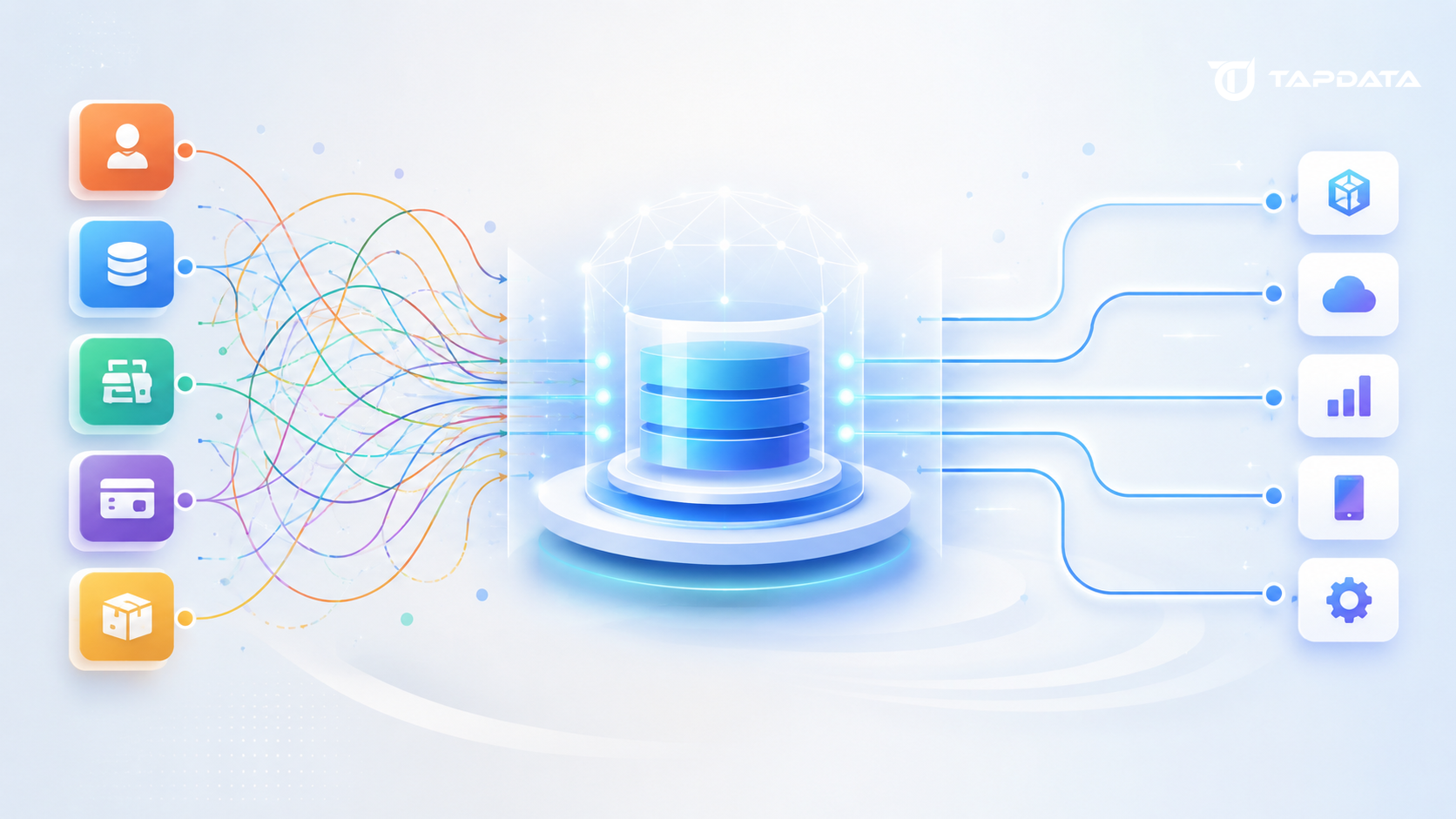
Modern enterprises rarely operate on a single system. Customer records may live in CRM platforms, transactions in payment systems, inventory in ERP databases, and order processing in fulfillment services. Each system manages its own data reliably within its domain.
However, as organizations attempt to connect these systems, a common integration pattern emerges: direct connections between systems. At first, this approach appears straightforward. A CRM system might send customer updates to an order management system, while an ERP platform synchronizes inventory with an e-commerce platform.
Over time, these connections multiply. What began as a small number of integrations gradually expands into a dense network of dependencies that becomes increasingly difficult to maintain.
Point-to-point integration is an architecture where operational systems exchange data through direct connections with each other. While this approach works well for a small number of systems, the number of integrations grows rapidly as organizations add more applications.As TapData describes in its data architecture research, many enterprises eventually reach a stage where managing dozens of system-to-system integrations becomes operationally fragile. At that point, teams often begin evaluating alternative patterns that reduce direct dependencies between systems.
Why Point-to-Point Integrations Seem Simple at First
Direct integrations are appealing because they solve immediate problems quickly. When two systems need to exchange data, building a direct connection often requires minimal infrastructure.
A typical example might look like this:
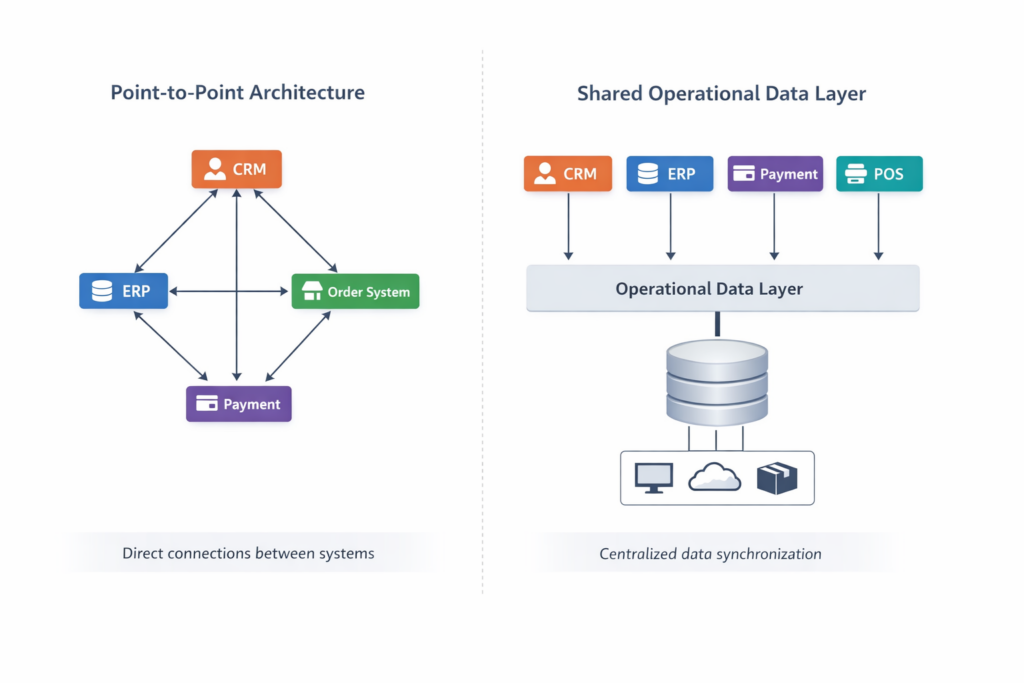
Each integration serves a specific operational need. For small systems or early-stage architectures, this approach can work effectively.
The challenge emerges when the number of systems grows.
How Integration Complexity Grows
As more applications require access to shared data, the number of integrations increases rapidly. Instead of a small set of connections, organizations begin managing a complex web of dependencies.
A simple architecture with five systems might already require dozens of integrations.
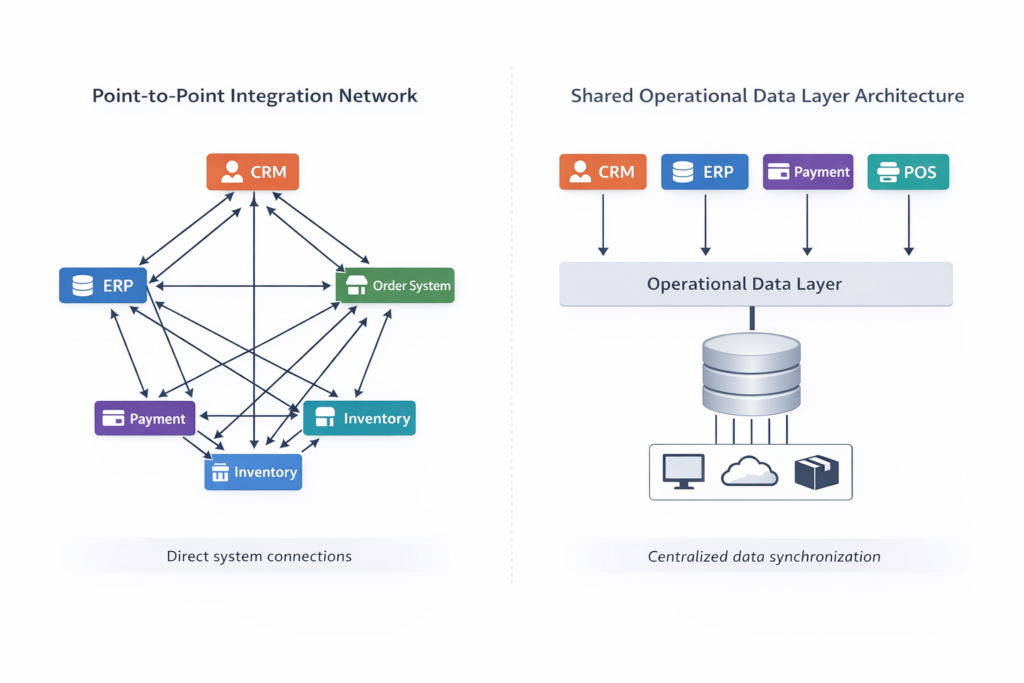
The problem is not simply the number of connections, but the interdependence between systems. Changes in one system can affect multiple integrations simultaneously.
Structural Challenges of Point-to-Point Integration
As integration networks expand, several structural problems begin to appear.
Integration Explosion
The number of connections grows faster than the number of systems. Every new system introduces additional integration requirements.
Schema Dependency
Direct integrations often depend on database schemas or API structures. When a source system changes its schema, downstream systems may break.
Ownership Conflicts
Operational systems typically belong to different teams. Changes required by one integration may conflict with the priorities or release cycles of another team.
Operational Fragility
Monitoring and troubleshooting become difficult because integration logic is distributed across many services, scripts, or pipelines.
These challenges are not caused by poor implementation. They are a natural consequence of architectures that rely heavily on direct system-to-system connections.
When Point-to-Point Integration Reaches Its Limits
Point-to-point architectures often work well for a small number of systems. The difficulty arises when organizations scale their applications and data usage.
At that stage, several symptoms usually appear:
-
multiple systems requesting the same data
-
duplicated integration pipelines
-
growing operational overhead
-
difficulty tracing data inconsistencies
When these symptoms emerge, organizations begin looking for architectural patterns that reduce system-to-system coupling.
A Different Approach: Shared Operational Data Access
Instead of connecting every system directly to every other system, some architectures introduce a shared layer responsible for synchronizing and exposing operational data.
In this approach, operational systems remain independent sources of truth, while a separate layer provides unified access to current operational data.
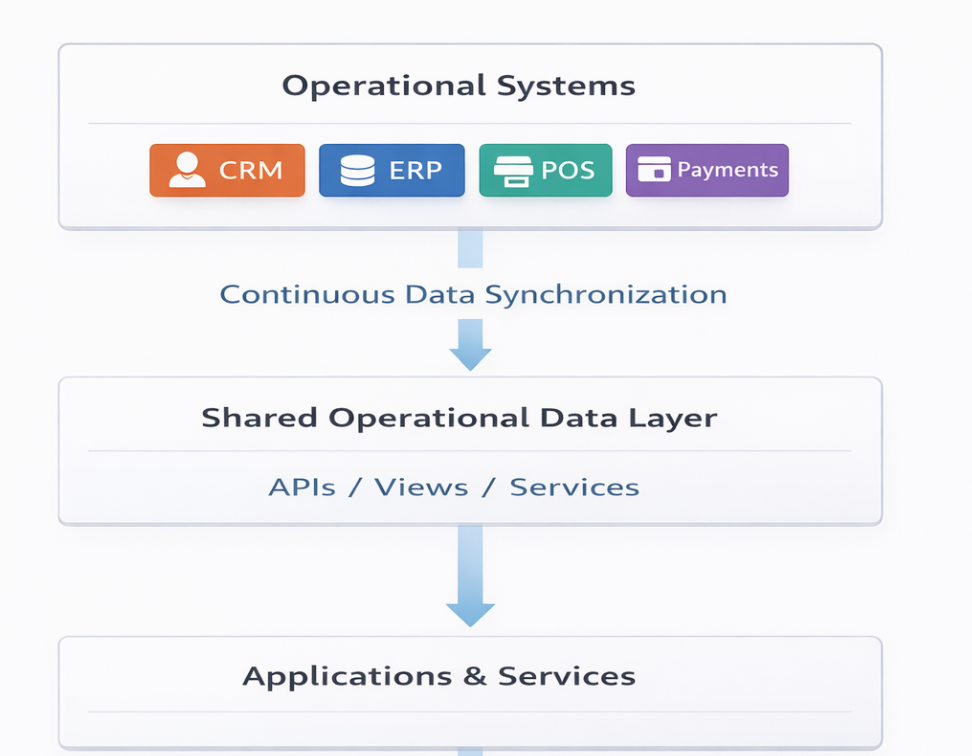
This architecture reduces the number of direct dependencies between systems and centralizes data synchronization responsibilities.
Point-to-Point Integration vs Shared Data Access
| Approach | Characteristics | Limitations |
| Point-to-point integration | Direct connections between systems | Complexity increases as systems grow |
| Centralized data warehouse | Optimized for analytics workloads | Not designed for operational application use |
| Shared operational data layer | Provides unified access to current operational data | Requires dedicated data synchronization infrastructure |
Each approach serves different architectural needs. The key challenge is choosing the right mechanism for operational data sharing across systems.
Frequently Asked Questions
Are point-to-point integrations always a bad design?
No. For small architectures with only a few systems, direct integrations can be efficient and easy to maintain. The challenge arises when the number of systems and data dependencies grows significantly.
Why do integrations multiply so quickly?
Most operational systems require access to data owned by other systems. When each system connects directly to others, the number of connections increases rapidly as the system landscape expands.
Do APIs solve the integration problem?
APIs provide structured access between applications, but they do not eliminate the need to synchronize or aggregate data from multiple systems. In many architectures, APIs are still part of the integration network.
When should organizations reconsider point-to-point integration?
When the number of integrations becomes difficult to track or maintain, or when multiple systems require the same operational data, it may be useful to evaluate alternative architectural patterns for data sharing.
Conclusion
Point-to-point integrations are a natural starting point for connecting operational systems. They are simple to implement and effective when the number of systems is small.
As organizations scale, however, these integrations tend to form increasingly complex networks of dependencies. Changes in one system ripple across others, and integration management becomes a significant operational burden.
Recognizing these limitations is often the first step toward adopting architectural patterns that reduce system coupling while still enabling applications to access the operational data they require.