
Modern enterprises run dozens — or even hundreds — of operational systems. Transaction databases support core applications such as CRM, ERP, POS, and payment platforms, while newer services introduce additional microservices databases and APIs. Each system works well in isolation, but once organizations attempt to share data between them, complexity grows rapidly.
Many teams initially assume that existing solutions such as data warehouses, API integrations, or event streaming pipelines can solve the problem. In practice, these approaches often address analytics or messaging needs rather than operational data sharing. As a result, enterprises frequently discover that something is missing in their architecture: a layer designed specifically to unify and serve operational data.
This gap is increasingly recognized as the operational data layer.
Why Operational Systems Naturally Create Data Silos
Operational systems are designed to optimize individual applications rather than cross-system collaboration. Each database maintains its own schema, data ownership rules, and transaction logic. This design is necessary for application performance and reliability, but it also creates structural barriers to data sharing.
Over time, organizations accumulate a fragmented landscape:
-
Customer information stored separately in CRM, e-commerce, and support systems
-
Inventory data maintained across ERP and warehouse management systems
-
Order history distributed between payment, logistics, and fulfillment platforms
When applications require a unified view—such as building a customer profile or synchronizing order status—teams often resort to custom integrations.
These integrations typically evolve into:
-
point-to-point API calls
-
batch ETL pipelines
-
message queues or streaming pipelines
While each approach solves a narrow problem, the overall integration landscape becomes increasingly complex as the number of systems grows.
What Is an Operational Data Layer?An operational data layer is a data architecture component that continuously synchronizes data from multiple operational systems and exposes it in a unified, application-ready form through APIs, views, or services.Instead of relying on point-to-point integrations or batch pipelines, the operational data layer provides a centralized foundation for sharing real-time operational data across applications.
Why Traditional Data Solutions Do Not Fully Solve the Problem
Enterprises often attempt to address operational data sharing using existing data infrastructure. However, most commonly used solutions were designed for different purposes.
| Architecture | Primary Purpose | Typical Latency | Limitations for Operational Data |
| Data Warehouse | Analytics and reporting | Minutes to hours | Not designed to serve application workloads |
| ETL Pipelines | Batch data integration | Minutes to hours | Difficult to maintain real-time synchronization |
| API Integration | Application connectivity | Real-time | Creates fragile point-to-point dependencies |
| Streaming Pipelines | Event processing | Seconds | Operational complexity grows quickly |
These technologies remain essential components of modern architectures. However, none of them directly address the problem of continuously synchronizing operational data and exposing it in a unified form for applications.
As organizations scale their systems, the gap becomes increasingly visible.
The Emergence of the Operational Data Layer
An operational data layer is an architectural layer designed to continuously synchronize data from operational systems and make it accessible to other applications in a consistent and real-time manner.
Instead of relying on dozens of direct integrations between systems, the operational data layer acts as a shared data foundation.
A typical operational data layer performs three core functions:
-
Continuous synchronization Changes from operational databases are captured and replicated in real time.
-
Unified data representation Data from multiple systems is normalized or combined into application-friendly models.
-
Application delivery Applications access data through APIs, views, or services instead of querying source systems directly.
This architecture separates operational data delivery from individual application databases, significantly reducing cross-system complexity.
How an Operational Data Layer Fits into Modern Architecture
The operational data layer typically sits between operational systems and downstream applications.
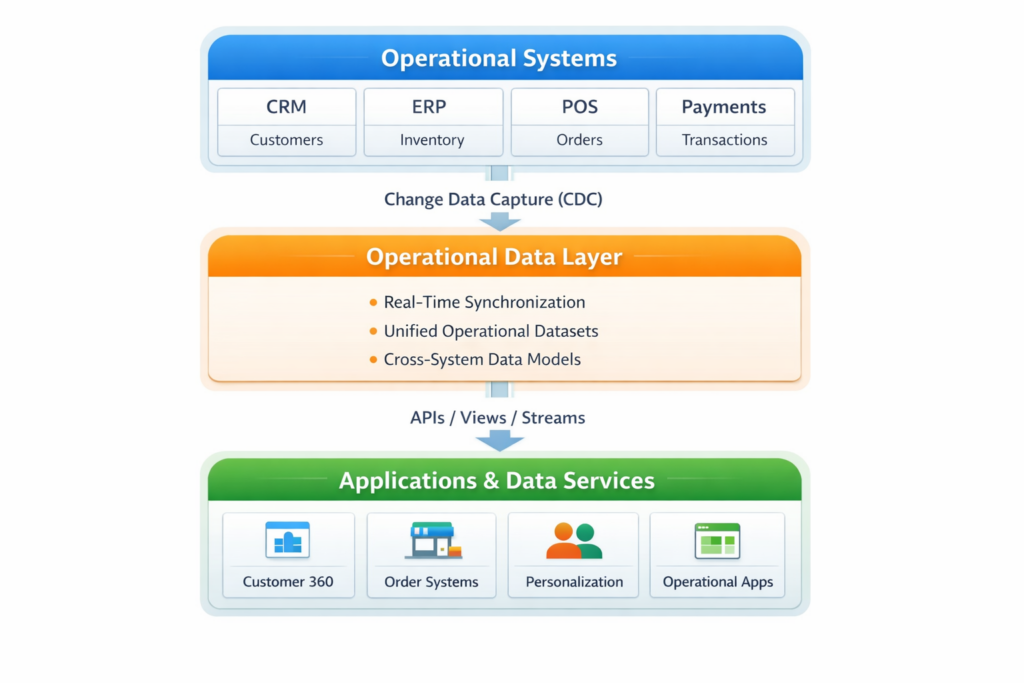
In this architecture, operational systems remain the authoritative source for transactions, while the operational data layer provides a unified access point for other services.
This approach prevents applications from directly querying production databases while still enabling near-real-time access to operational information.
Key Benefits of Introducing an Operational Data Layer
Organizations adopting an operational data layer often see improvements in both system architecture and operational efficiency.
First, it reduces the number of point-to-point integrations between systems. Instead of connecting every system to every other system, applications retrieve data from a single operational data foundation.
Second, it simplifies real-time data delivery. Rather than building and maintaining numerous pipelines, synchronization is handled centrally.
Third, it protects operational databases from excessive query workloads. Applications access derived datasets rather than directly querying production systems.
Finally, it enables faster development of data-driven applications such as customer 360 platforms, order tracking systems, and real-time operational dashboards.
Where the Operational Data Layer Is Most Useful
The operational data layer pattern is especially valuable in environments where multiple operational systems must collaborate in real time.
Common examples include:
-
Customer 360 platforms that unify CRM, transaction, and engagement data
-
Order lifecycle systems that combine payment, logistics, and inventory updates
-
Operational dashboards that monitor live business activity across systems
-
Real-time data services supporting modern applications and APIs
In these scenarios, the operational data layer acts as a shared foundation that enables applications to access unified operational data without introducing fragile integrations.
A Growing Pattern in Modern Data Architectures
As enterprises modernize their data architectures, the operational data layer is increasingly recognized as a missing component between operational databases and applications.
Data warehouses remain essential for analytics. Event streaming platforms support event-driven architectures. APIs enable application communication.
However, none of these layers alone provides a unified, continuously synchronized operational dataset.
The operational data layer fills this gap by enabling systems to share operational data in real time while maintaining clear ownership boundaries for source databases.
FAQs About the Operational Data Layer
Is an operational data layer the same as a data warehouse?
No. A data warehouse is designed for analytical workloads such as reporting and historical analysis. An operational data layer focuses on delivering current operational data to applications and services in near real time.
How is an operational data layer different from ETL pipelines?
ETL pipelines typically move data in batches for analytics platforms.
An operational data layer continuously synchronizes changes from operational systems and exposes unified datasets that applications can use directly.
Does an operational data layer replace APIs between systems?
Not necessarily. APIs remain important for application communication.
However, the operational data layer reduces the need for complex point-to-point integrations by providing a shared data foundation.
When do enterprises need an operational data layer?
Organizations typically benefit from an operational data layer when multiple operational systems must share data in real time—for example in customer 360 platforms, order lifecycle systems, and real-time operational dashboards.
Conclusion
Operational systems were never designed to share data seamlessly with one another. As organizations scale their applications, integration complexity grows quickly, often resulting in fragile pipelines and duplicated data flows.
Introducing an operational data layer provides a structured way to unify operational data without tightly coupling systems together. By continuously synchronizing source systems and exposing unified datasets to applications, this architectural pattern simplifies real-time data access across the enterprise.
For organizations building customer platforms, operational dashboards, or real-time applications, the operational data layer is increasingly becoming a foundational component of modern data architecture.