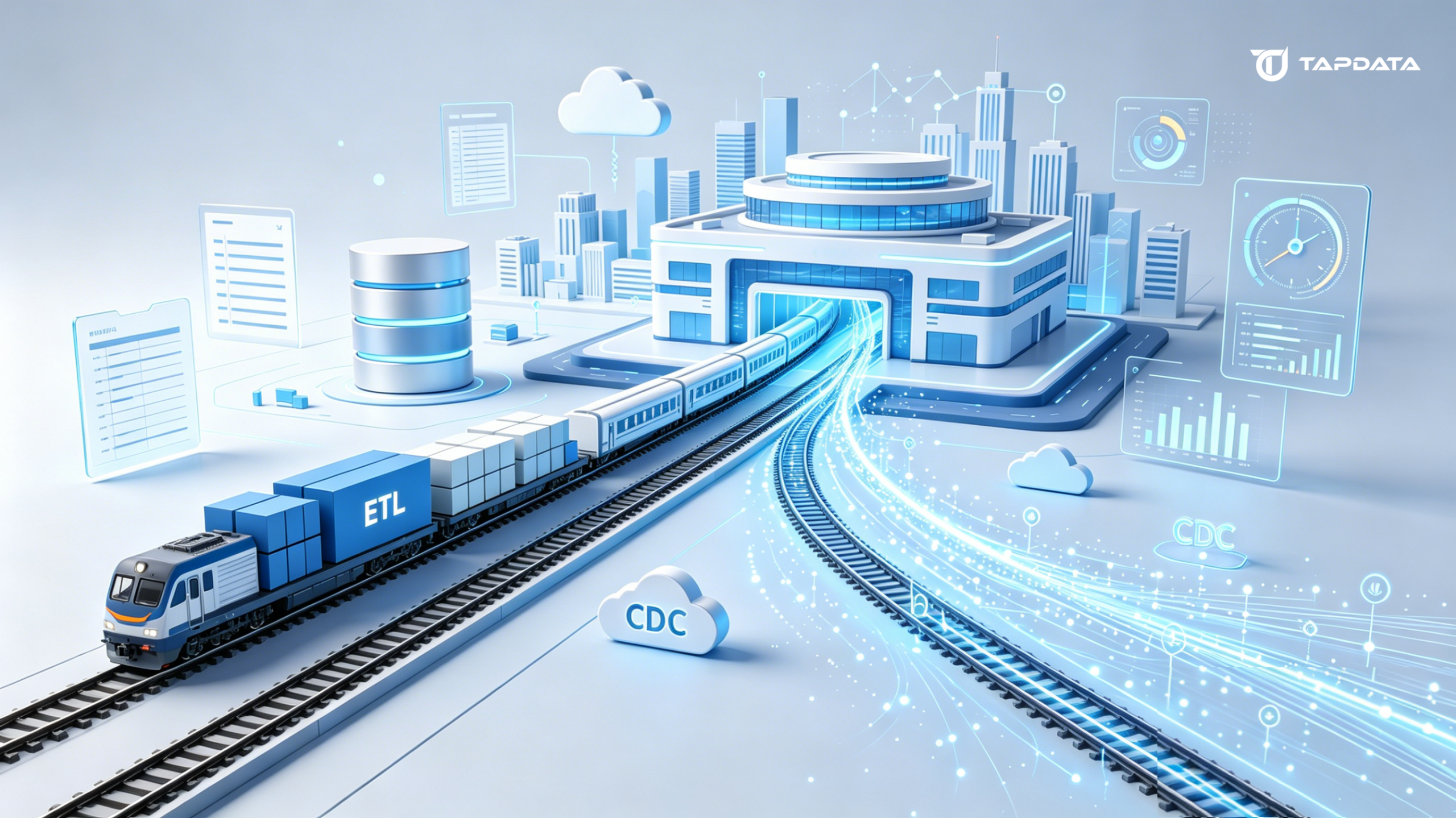
In the era of real-time decisions, API-driven architectures, and AI-ready data stacks, choosing the right data movement strategy is critical. Should you use traditional ETL (Extract, Transform, Load) or adopt CDC (Change Data Capture)?
This guide breaks down the differences, trade-offs, and best-fit scenarios for both.
What Is ETL?
ETL—Extract, Transform, Load—is a long-established process in data engineering. It extracts full data sets from source systems, transforms them (e.g., joins, cleans, reshapes), and then loads them into target systems such as a data warehouse.
Traditional ETL Characteristics:
-
Batch-based (runs every few hours/days)
-
Often introduces data latency
-
High system load during extraction
-
Typically used for historical reporting and BI
What Is CDC?
Change Data Capture (CDC) captures and delivers only the changes—inserts, updates, and deletes—from a database in near real-time. CDC continuously feeds downstream systems with fresh data.
CDC Characteristics:
-
Event-driven and real-time
-
Low source system overhead
-
Ideal for operational dashboards, APIs, and microservices
-
Enables high-speed data services and fast decision-making
CDC vs ETL: Head-to-Head Comparison
| Feature | ETL | CDC |
| Latency | Hours or days | Seconds or less |
| Data Volume | Full datasets | Only changes |
| Source Load | High | Low (especially with log-based CDC) |
| Use Cases | Historical analytics, periodic reporting | Real-time analytics, digital services |
| Transformation | Done before load | Often done post-ingestion |
| Architecture Fit | Monolithic, centralized | Distributed, event-driven |
| Complexity | Simpler to begin, but brittle at scale | Requires deeper integration, but scales better |
| Maintenance | Frequent rebuilds as schema changes | Adaptable with schema evolution support |
When to Use ETL
ETL still plays an important role in many modern data ecosystems. It is well-suited for:
-
Periodic, non-urgent data refreshes
-
Historical or regulatory reporting
-
Large-scale data cleansing and reshaping
-
Migrations involving deep restructuring
For example, if you're loading five years of sales data into a Snowflake warehouse for quarterly planning, batch ETL may be sufficient.
When to Use CDC
CDC shines when speed, freshness, and agility matter. Ideal use cases include:
-
Real-time analytics dashboards (sales performance, fraud alerts)
-
Microservices data sync between domains or regions
-
Event-driven workflows (e.g., trigger app updates on data changes)
-
API delivery of live data to internal/external consumers
-
Cloud migrations with minimal downtime
-
Feeding AI/ML pipelines with always-fresh features
Example: An ecommerce platform needs product inventory to update instantly across the website, mobile app, POS, and 3rd-party marketplaces. Waiting for nightly ETL isn’t viable—CDC is the answer.
Hybrid Approach: Best of Both Worlds?
Many mature organizations use CDC and ETL side by side:
-
CDC powers real-time services, low-latency dashboards, and streaming consumers.
-
ETL supports deep analytics, full-data snapshots, and historical archives.
In this hybrid model, CDC serves as the “operational backbone”, while ETL handles strategic intelligence.
TapData: Accelerating CDC Adoption
While ETL tools are widely available, adopting CDC can be challenging due to:
-
Complex log parsing
-
Schema evolution management
-
Lack of visibility or monitoring
TapData simplifies CDC adoption by providing:
-
Log-based CDC for major databases (Oracle, MySQL, SQL Server, PostgreSQL, MongoDB)
-
Built-in transformation, validation, and schema evolution
-
Real-time incremental materialized views for analytics and APIs
-
Monitoring, offset checkpoints, lineage tracking
-
Low-code experience with enterprise-grade reliability
Discover how TapData helps you move from batch to real-time →
Final Thoughts: Choose What Moves Your Business Forward
The choice between CDC and ETL isn’t binary—it’s strategic.
-
If speed, consistency, and service freshness matter, start with CDC.
-
If deep historical analysis or restructured loads are your goal, ETL is still valid.
-
If you need both agility and depth, combine the two.
In a world where users expect up-to-date experiences, real-time integration is no longer optional—it’s essential.
“We didn’t just need another warehouse report. We needed data that moved as fast as our business.”